
Energy Recovery from Industrial Wastewater
Integration of AD Systems into Existing Activated Sludge Plants
Conventional activated sludge systems are highly effective for wastewater polishing — but they come at a significant operational cost.
Aerobic treatment processes are among the largest electricity consumers within industrial facilities. Aeration alone can account for 50–70% of the total energy demand of a wastewater treatment plant. Continuous blower operation, oxygen transfer requirements, and mixing systems make aerobic treatment inherently energy-intensive.
In addition, aerobic systems generate large volumes of excess biological sludge.
This sludge must be thickened, dewatered, transported, and disposed of — creating substantial handling costs and long-term environmental liabilities.
Furthermore, aerobic plants require continuous operational control, skilled supervision, and intensive maintenance. Shock loads, production peaks, and organic fluctuations can destabilize the system, requiring constant monitoring and operational adjustments.
For industries with high-strength wastewater — such as poultry and food processing — these limitations become even more pronounced.
A More Efficient and Sustainable Alternative
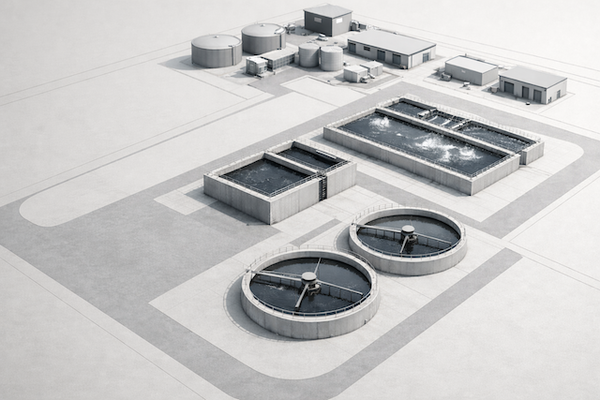
Conventional activated sludge wastewater treatment plant, high energy demand and sludge production
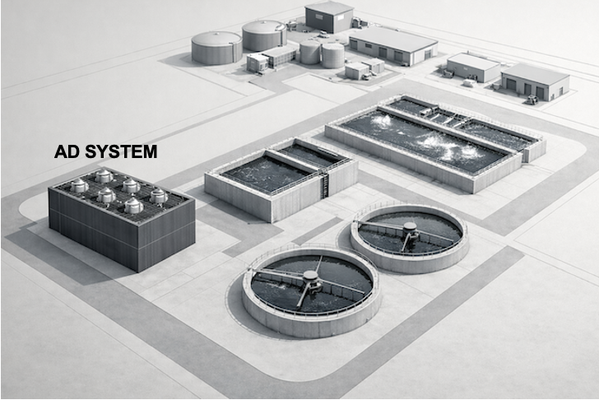
Activated sludge WWTP improved with an AD system at the head
Anaerobic treatment offers a fundamentally different approach
Instead of consuming large amounts of electricity to oxidize organic matter, anaerobic systems convert that organic load into renewable energy in the form of biogas.
By integrating an AD system or UASB reactor upstream of the aerobic stage, high-strength industrial wastewater can be treated efficiently while simultaneously generating value.
This approach allows:
1. Significant Energy Reduction
By removing a large portion of the organic load (COD/BOD) before the aerobic stage, the aeration demand is substantially reduced. Since aeration typically represents 50–70% of total plant energy consumption, this translates into major operational savings.
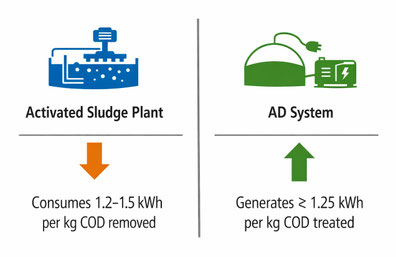
- Aerobic treatment consumes large amounts of electricity due to continuous aeration.
- Requires ⚠️ 1,2 – 1,5 kWh/kg DQO degraded.
Instead:
- Anaerobic systems require no oxygen injection
- Energy Production Instead of Energy Consumption
- Organic matter is converted into biogas (methane)
- Biogas is used in CHP units for electricity and heat generation
- Steam boilers can operate directly with biogas
- Energy self-sufficiency becomes achievable
- Wastewater treatment becomes an energy asset, not a cost center.
2. Biogas Production and Energy Recovery
The AD System converts organic matter into biogas, creating a renewable energy source from wastewater itself. This allows partial or full energy self-sufficiency, depending on plant size and influent characteristics.
The AD System produces up to ⚠️ 0.35 Nm³ CH₄ per kg COD removed, equivalent to >= 1,25 kWh of electricity..
3. Increased Hydraulic and Organic Capacity
Pre-treatment in the AD System reduces the load on aeration tanks and clarifiers, effectively increasing the treatment capacity of the existing plant without major civil expansion.
4. Reduced Sludge Production
Anaerobic treatment generates significantly less excess sludge compared to aerobic processes. This lowers sludge handling, dewatering, transport, and disposal costs.
5. Lower Operational Costs
Reduced aeration demand, lower sludge production, and energy recovery combine to decrease overall OPEX.
6. Retrofit-Friendly Solution
The Anaerobic treatment can be installed at the plant headworks with minimal disruption to existing infrastructure. It enhances performance without requiring a complete redesign of the biological system.
7. Improved Process Stability
By buffering shock loads and reducing organic fluctuations before the aerobic stage, overall plant stability improves.
8. Contribution to Decarbonization Goals
The integration supports carbon footprint reduction by lowering electricity consumption and generating renewable biogas, aligning the facility with modern sustainability and ESG targets.
Rather than expanding aeration capacity and increasing electricity consumption, industries can recover energy directly from their wastewater.
In particular, there are two agro-industrial sectors that can greatly benefit from integrating an anaerobic system at the headworks of their activated sludge WWTP, in order to reduce operating costs and produce energy:
a) Dairy processing plants
b) Poultry slaughterhouses and processing plants
Download more information here to reduce your operating costs at your activated sludge treatment plant
Request at no cost a Preliminary Savings Assessment
If you would like to evaluate the potential benefits for your facility, please send us the following information:
-
Average wastewater flow (m³/day)
-
Influent COD (DQO)
-
Influent BOD₅ (DBO₅)
-
Current electricity cost (€/kWh) (optional but recommended)
Based on this data, Aqualimpia will provide a preliminary technical and economic assessment outlining the estimated energy recovery potential, reduction in operating costs, and expected payback period for integrating an anaerobic system upstream of your existing activated sludge plant.